
AGRIZEN
Kenya's Markets Are Selling More Than Vegetables: A New Study Flags a Pesticide Problem
Health Desk
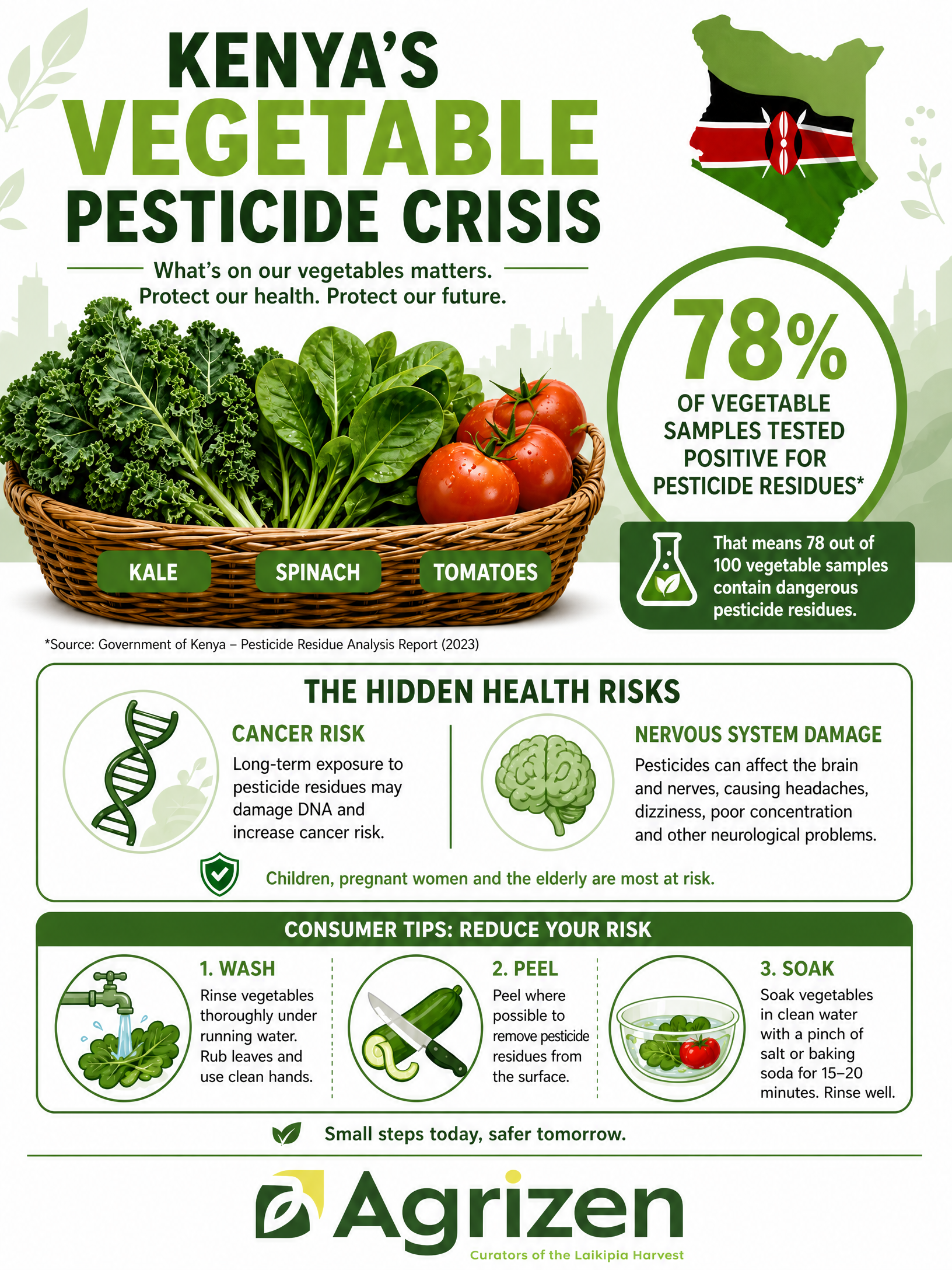
For millions of Kenyan households, a trip to the local market for kale, spinach, tomatoes, or onions is a routine, unremarkable errand. But a recently released scientific study suggests that routine may carry a hidden cost. Researchers tested 45 samples of common vegetables bought from major markets, including Muthurwa, Githurai, and Kangemi in Nairobi, along with a market in Nakuru, and found that roughly four out of every five samples carried detectable pesticide residue.
The research, titled "Pesticide Residues in Selected Vegetables Sold in Kenyan Markets," was carried out by the Kenya Organic Agriculture Network (KOAN) together with the University of Nairobi and the Route to Food Initiative, with backing from the Swedish Society for Nature Conservation and the Heinrich Böll Foundation. Of the 45 samples analysed, 35, or about 78 percent, showed measurable pesticide residues. More concerning, roughly a third of all samples exceeded the maximum residue limits set by the European Union, a benchmark widely used as a proxy for food safety even outside Europe.
Kale and Spinach Carried the Heaviest Chemical Load
Not all vegetables were equally affected. According to the researchers, tomatoes had the highest share of non-compliant samples, with spinach and kale close behind; none of the onion samples tested exceeded the applicable limits. Leafy greens such as kale and spinach were found to carry the widest chemical mix, with some samples showing traces of up to seven distinct pesticide compounds in a single serving-sized portion. Toxicologist Dr. Nduhiu Gitahi of the University of Nairobi, who presented the findings, explained that the study was carried out in two stages: the first measured how much pesticide residue was present on vegetables as sold, and the second examined whether ordinary kitchen practices, such as washing, peeling, soaking, or cooking, could meaningfully cut that exposure before food reaches the plate.
Why the Chemicals Detected Matter
The specific compounds identified are not new to Kenyan agriculture, but their cumulative presence is what worries public health researchers. Several of the pesticides linked to
non-compliant samples are associated, in scientific literature, with disruption of the endocrine system, damage to the nervous system, harm to reproductive health, and, with long-term, high-level exposure, elevated cancer risk. These are not acute poisoning cases; the concern is chronic, low-dose exposure accumulated meal after meal, year after year, particularly for children and pregnant women.
This is not the first Kenyan study to raise this alarm. A 2018 assessment carried out under the USAID FOODSCAP project found pesticide residues in 46 percent of nearly 1,140 fresh produce samples tested by the Kenya Plant Health Inspectorate Service, with kale, peas, and capsicum among the worst offenders. A separate Route to Food report has previously found that nearly half of all pesticide products registered for use in Kenya are classified as toxic to humans in some form, and that dozens of active ingredients still approved locally have already been restricted or withdrawn in the European market.
Where the Responsibility Lies
The report's authors are careful to note that the findings are not a reason for consumers to panic or stop eating vegetables, since proper washing and preparation can meaningfully reduce residue levels on produce brought home from the market. But they stress that the primary responsibility for closing this gap does not rest with households. It sits further up the chain, with farmers who apply pesticides, the companies that manufacture and market them, and the regulators, chiefly the Pest Control Products Board, tasked with deciding which chemicals may be sold and how they should be used.
Advocacy groups have pointed out that Kenya continues to register and permit the use of several active ingredients that are banned or heavily restricted in the European Union and other jurisdictions, often because they remain cheaper or more readily available to smallholder farmers than safer alternatives. Lawmakers have periodically proposed legislation to ban a list of hazardous chemicals outright, though such efforts have moved slowly against resistance from parts of the agricultural input industry.
What Consumers Can Do in the Meantime
Food safety experts generally recommend a few practical steps while structural reforms play out: washing vegetables thoroughly under running water, soaking leafy greens briefly before use, peeling produce such as tomatoes and onions where practical, and diversifying vegetable sources rather than relying on a single supplier. None of these steps eliminate risk entirely, but researchers say they can meaningfully lower the residue load that ends up on a plate.
For now, the study adds to a growing body of Kenyan research pointing in the same direction: pesticide use in the country's food system is widespread, only loosely monitored, and
increasingly linked, by both local and international researchers, to long-term health risks that fall hardest on the people who can least afford to eat elsewhere.
The Regional Picture
Kenya's experience is not unique on the continent. A broader regional review published earlier this year found that highly hazardous pesticides make up close to half of all registered pesticide products across Kenya, Ghana, and South Africa, yet account for an even larger share, by some estimates around three-quarters, of what is actually used in the field, since cheaper hazardous formulations tend to be favoured by cost-conscious farmers. The same review found that only a small fraction of soil samples tested across these countries were entirely free of pesticide residue, a contamination rate researchers say is comparable to parts of Europe, despite far less systematic monitoring in African markets.
Researchers argue this regional pattern reflects a structural imbalance rather than isolated negligence: manufacturers can legally sell products in African markets that have already been withdrawn or restricted elsewhere, regulatory bodies are often under-resourced relative to the scale of agricultural chemical use they are meant to oversee, and farmers frequently lack affordable access to safer alternatives or the training to apply approved chemicals at the correct dose and timing.
The Road Ahead
Public health advocates say the latest KOAN-led findings should renew pressure on two fronts at once: tighter enforcement of existing pesticide regulations, including random market testing of the kind used in this study, and faster movement on stalled legislative proposals to withdraw the most hazardous chemicals from the Kenyan market altogether. Until then, researchers say, the burden of managing risk will continue to fall disproportionately on households, through washing, soaking, and hoping, rather than on the regulatory system meant to catch the problem before it reaches the market stall.
How Agrizen Fits Into the Solution
Platforms like Agrizen point to a different way around this problem altogether: sidestepping the pesticide and fertilizer question entirely. Agrizen is an e-commerce platform that sells only organically grown produce and organically raised cattle, sourced from farmers who forgo synthetic pesticides and chemical fertilizers in the first place. Rather than helping households manage residue after the fact, through washing, soaking, or hoping, Agrizen's model is built around giving customers a direct line to food that was never exposed to the chemicals flagged in studies like this one, offering an organic alternative for shoppers who want certainty about what ends up on their plate.